
Roller Press Granulator | EMCC Fertilizer Granulation Equipment
Roller Press Granulator Product Overview
The roller press granulator is a dry granulation fertilizer equipment (Dry Granulation Equipment): two counter-rotating rollers compress powdered fertilizer into strong, dense granules at room temperature in a single pass. This equipment is widely used in fertilizer, pharmaceutical, and chemical industries, and is particularly suitable for granulating ammonium bicarbonate, urea, ammonium chloride, ammonium sulfate, potassium chloride, potassium sulfate, compound fertilizer, NPK, and other granular fertilizers.
Materials Suitable for Double Roller Extrusion Granulation
EMCC Roller Press Granulator are suitable for:
▢ Inorganic Fertilizers granulation: NPK fertilizer, compound fertilizer, ammonium bicarbonate, urea, ammonium chloride, ammonium sulfate, potassium chloride, potassium sulfate, salts, etc.
▢ Organic Fertilizers granulation: Humic acid, bio-organic fertilizer, fermented livestock manure, etc.
▢ Other Materials granulation: Mineral powders, chemical raw materials, etc.
Production Capacity Range
Roller press granulators are often configured in parallel for granulation lines, suitable for production lines from 1 TPH to 50 TPH .
The processing capacity for a single unit is: 1 – 1.5 TPH
Dry roller press granulator for NPK, compound & organic fertilizer. No drying required. Customization and parallel design are available to match fertilizer production lines of different scales according to customer requirements.
Roller Press Granulator Working Principle & Core Advantages
The core of the roller press granulator is the dry extrusion molding process. The working principle is: a motor drives a pair of counter-rotating high-pressure rollers, forcing dry powder material into a narrow nip zone. Under high mechanical pressure of 20-30 MPa, the material is compacted into a dense, hard sheet, which is then crushed in a flake breaker and sized via a vibrating screen to obtain the final granules. This process requires no water addition or drying, is energy-efficient and environmentally friendly, and is widely used in dry granulation production for compound and organic fertilizers.
✅︎ No Drying Required: One-step forming with only 2%-5% moisture content, reducing energy consumption by 30%-40% .
✅︎ Eco-Friendly & Low Maintenance: Zero wastewater, exhaust gas, or solid waste discharge. Compliant with Class A environmental performance standards.
✅︎ Compact Footprint: Extremely short process flow, occupying only 1/3 of the floor space of conventional lines.
✅︎ Cold Granulation: Suitable for organic/inorganic/bio-fertilizers. Microbial survival rate >90% .
✅︎ Ideal for Heat-Sensitive Fertilizers: The only proven large-scale dry granulation solution for ammonium bicarbonate and rare earth fertilizers.
EMCC Customization Roller Press Granulator Capabilities
EMCC offers full-parameter custom design based on different process requirements, including:
▢ Flexible Capacity Parallel Customization: Parallel operation with balanced material distribution to prevent bridging/stalling. Capacity covers 20,000 – 500,000 TPY. Single machine maintenance does not halt production.
▢ Compact Vertical Layout: Tower or split-level design utilizing gravity flow, saving 30% floor space. Ideal for retrofitting existing plants or space-constrained projects.
▢ Special Material Process Adjustment: Custom screw feeder parameters and screen angles to handle difficult materials like high-fiber or ultra-light powders.
▢ Full-Process Automation Control: PLC interlock programming for one-touch start/stop and automatic fault diversion, ensuring stable operation of parallel units.
▢ Turnkey Project Service: Complete solutions from raw material analysis and plant layout design to manufacturing, installation, and operator training—delivery to production .
EMCC Roller Press Granulator Technical Specifications
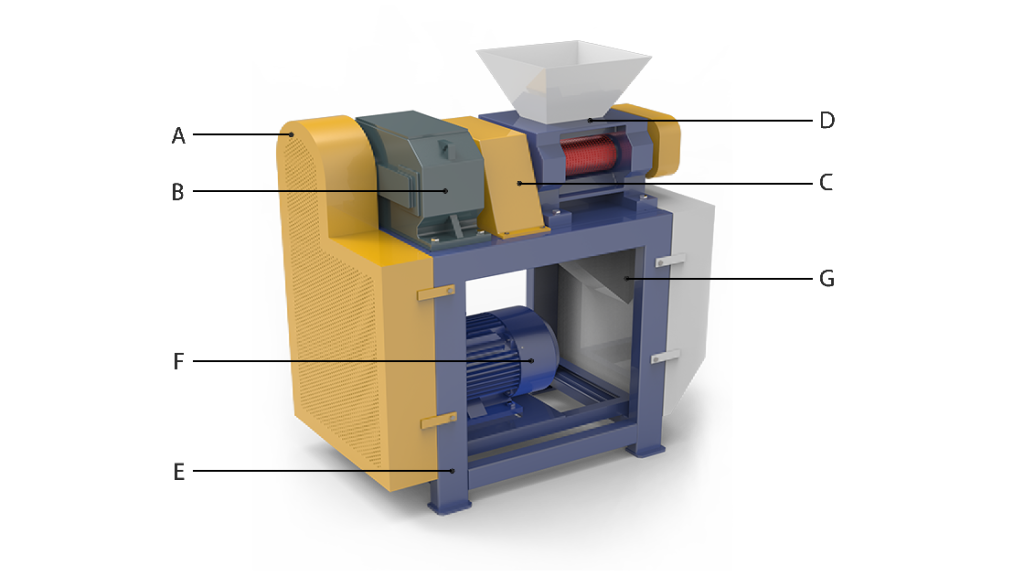
A – Drive Mechanism Cover
B – Gear Reducer
C – Coupling Guard
D – Roller Press Granulating Unit
E – Frame Structure
F – Motor
G – Discharge Outlet
Basic Technical Parameters Table
The above are the basic parameters of EMCC roller press granulators. If you need roller granulator with larger unit capacity, we also supply heavy-duty type, which unit capacity up to 50TPH. For specific parameters, design drawings, or a quote tailored to your material, please 【Contact EMCC Engineer】 or 【Visit Official Website for Complete Cases】 .
● Supporting equipment: Crusher, Mixer, Elevator, Belt Conveyor
● Supporting environmentally friendly dust removal equipment: Pulse Dust Collector, Spray Tower
● Thermal equipment: Combustion Device
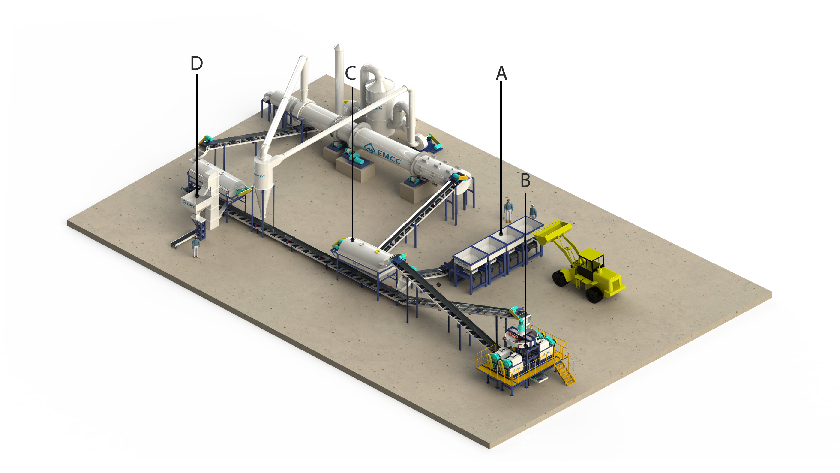
EMCC provides complete fertilizer production line solutions from batching, granulation, screening, coating to packaging, with customized design based on customer capacity and process requirements.
Fertilizer raw material batching → Pretreatment and crushing → Mixing → Granulation → Drying → Cooling → Screening and recycling → Coating → Packaging → Finished product. (Note: Dry granulation significantly reduces the need for thermal treatment. However, high-capacity industrial roller compactor granulation lines may consider an optional simple drying/cooling step to ensure optimal throughput and storage stability.)
For specific parameters, design drawings, or a quote tailored to your material, please 【Contact EMCC Engineer】 or 【Visit Official Website for Complete Cases】 .
Technical Deep Dive
The following content elaborates on the advantages and process paths of the roller press granulator in fertilizer production. For testing services tailored to your material, please 【Visit Official Website for Testing Center】 or 【Contact Engineer to Schedule Material Testing】 .
Why choose a roller extrusion granulator for fertilizer production?
● Low Energy & Cost: No drying required. Energy consumption down 30%-50% , cost per ton down 20%-30% , total investment saved 40%-60% .
● Versatile Material Adaptability: Suitable for organic, inorganic, biological, and compound fertilizers, as well as various powders and fibrous materials.
● Cold Granulation Preserves Actives: Room temperature extrusion protects heat-sensitive materials. Proven solution for large-scale ammonium bicarbonate granulation. Microbial survival rate >90% .
● High Particle Strength: 20-30 MPa high-pressure forming ensures high granule strength and >93% granulation rate. Customizable particle shapes.
● Environmental Compliance: Dry process with zero wastewater, gas, or solid waste discharge. Dust is recycled. Meets green production standards.
● Small Footprint & Easy Operation: Compact structure occupies only 2-3 m² . Operable by 1-2 persons. Maintenance focuses mainly on roller shells and bearings.
● Fast ROI: Eliminates drying/cooling equipment investment. Low initial cost, short startup time. Ideal for SMEs and startups.
Typical Process Pathways:
Standard Equipment and Production Line Design
The principle of the roller press granulator is straightforward: dry powder enters the roller gap and is compacted under high pressure. However, achieving uniform particle strength, high granulation rate, and stable operation at high capacity requires professional design capability and deep process understanding.
We not only provide reliable products, but more importantly, we provide reliable process design and experimentation.
EMCC Focuses on the Following During the Design Phase:
● Is the material organic or inorganic ?
● What is the target nutrient content ?
Key Design Parameters:
● Capacity: Customized per requirement (TPH), supports multi-machine parallel expansion.
● Pressure: Precisely adjustable hydraulic pressure ensures dense, non-friable sheets.
● Material: Roller shell material selected based on specific material abrasiveness.
The following content elaborates on how testing ensures the feasibility of the granulation process and equipment performance. For testing services tailored to your material, please 【Visit Official Website for Testing Center】 or 【Contact Engineer to Schedule Material Testing】 .
Why is Testing So Important?
Roller press granulation is a dry pressure agglomeration process. Material is compacted at room temperature without additives. Given significant variations in hardness, plasticity, fiber content, and moisture (even batch-to-batch), successful granulation relies entirely on precise material characterization. Comprehensive testing is the essential first step to mitigate project risk.
Conducting material testing at the EMCC Innovation Center allows you to:
✅ Verify feasibility of dry granulation for target materials.
✅ Obtain critical design data: pressure, roll gap, feed parameters .
✅ Identify potential issues (sheet friability, sticking, non-forming) before scale-up .
✅ Reduce project risk and avoid equipment misselection or production loss.
📌 Note: “Granulation” here refers specifically to dry extrusion granulation (also known as roller press granulation or pressure agglomeration). Material moisture content is typically controlled at 2%-5% , and no drying step is required.
How Testing Influences Roller Press Design:
While the machine appears simple, stable operation and consistent quality depend on precise design based on test data. Designs lacking test validation risk: material failing to compact, rapid roller wear, capacity shortfalls, and high recycle rates.
A comprehensive testing program provides the following core values:
1️⃣ Evaluate Unique Material Response to Dry Extrusion —— Characteristics influencing design:
▢ Moisture Content: Strictly 2%-5% .
▢ Particle Size Distribution: Affects packing density and sheet densification.
▢ Bulk Density & Plasticity Index: Determine compressibility under pressure.
▢ Fiber Content & Hardness: Dictate feeder structure and roller material.
▢ Abrasiveness: Determines roller surface treatment.
Testing helps determine preprocessing needs (e.g., grinding, moisture conditioning).
2️⃣ Gather Critical Process Data —— Key parameters identified during testing:
▢ Extrusion Pressure: Directly affects sheet density (typically 20-30 MPa).
▢ Roll Gap: Controls sheet thickness and subsequent particle size distribution.
▢ Feeder Screw Speed: Ensures uniform feed to prevent starvation or overfeeding.
▢ Roll Speed: Affects residence time and de-aeration in the nip zone.
▢ Recycle Ratio: Fine return ratio affects new material compaction.
▢ Pre-treatment Requirements: Crushing, screening, or micro-moisture adjustment needs.
3️⃣ Identify Potential Issues and Mitigate Scale-Up Risks —— Issues not apparent in bench-scale tests can emerge during scale-up:
▢ Flowability Issues: Bridging or segregation in full-scale feed hoppers.
▢ Sheet Quality Variation: Delamination or friability due to different linear speeds on larger rolls.
▢ Fiber Wrapping: Fibrous materials wrapping rollers or clogging feeders in continuous runs.
Pilot-scale testing uncovers these effects early, allowing design adjustments before fabrication.
Roller Press Granulator Frequently Asked Questions (FAQ)
The following FAQ not only covers surface-level symptoms, but delves deeper into underlying mechanisms and systematic troubleshooting methods. For a customized solution tailored to your specific material, please [Visit the EMCC Main Site to View the Complete Product Line] or [Contact an Engineer for a Free Assessment].
Answer: The failure to form flakes in a double roller extrusion granulator is usually caused by the material not being effectively drawn into the nip or by pressure leakage at the roller gap. If bridging and blockage occur in the hopper, installing a de-arching air cushion or vibratory feeder will resolve the issue. If the roller surface pockets have worn smooth and lost their gripping ability, the roller shell must be repaired or replaced. Operationally, strictly control the material moisture content within the optimal 2% to 5% window—the material should form a lump when squeezed but crumble when touched. Additionally, check the accumulator nitrogen pressure in the hydraulic system to maintain the dynamic compensation capability of the roller gap.
Answer: Insufficient strength in dry extrusion granulation stems from low internal density of the flake and the presence of micro-cracks caused by pressure release. For materials with high elastic after-effect, such as ammonium chloride, add a small amount of plasticizer like starch gelatinization liquid or humic acid powder to absorb internal stress. Select a large-diameter, slow-speed roller to extend the compression dwell time, allowing pressure to transmit to the core. It is also recommended to use elliptical or pillow-shaped pockets on the roller surface to reduce stress damage during demolding.
Answer: Addressing sticking in a double roller extrusion granulator requires isolation and temperature control rather than just forceful scraping. Micro-spray 0.1% to 0.5% magnesium stearate powder into the material to form a release film on the roller surface. When processing low-melting-point materials like urea, activate the internal roller water cooling system to prevent heat-softening adhesion. Ensure the use of phosphor bronze scraper blades (hardness slightly lower than the roller shell) fitted tightly against the roller surface for effective peeling without damaging the shell.
Answer: To extend the life of roller shells in a double roller extrusion granulator, adopt a hardness gradient design with a tungsten carbide overlay achieving a surface hardness above HRC 62. Utilize a slight differential speed of 1% to 2% between the drive and driven rollers to create a grinding self-sharpening effect. Additionally, modify the feed screw to a variable-pitch pre-compaction design to eliminate the erosive “jet flow” of loose material at the roller nip.
Answer: Low-frequency vibration in a roller press granulator is often caused by roller mass imbalance or misalignment. Use a vibration analyzer to differentiate between 1x and 2x running speed frequencies to diagnose uneven buildup or alignment issues. Structurally, install industrial rubber damping pads under the machine base and select C3 or C4 large-clearance bearings to allow for thermal expansion and prevent bearing seizure.
Answer: Bimodal size distribution in the finished product is caused by uneven feeding density and mismatched crusher speed. Install a perforated rectifying plate inside the hopper to force uniform material distribution across the roller width. Adjust the crusher claw tip speed via a VFD to find the critical speed that minimizes both over-crushing and the generation of oversized chunks.
Answer: High bearing temperature in a double roller granulator requires distinguishing between conducted heat and frictional heat. If heat is conducted from hot recycle material, activate internal water cooling for the main shaft. For lubrication, only No. 2 or No. 3 extreme pressure lithium grease containing molybdenum disulfide should be used; standard grease lacks the film strength for this heavy-load, low-speed application. During installation, strictly control the interference fit between the shaft and bearing inner ring to prevent loss of internal clearance and dry running.
Answer: Reducing the recycle rate in a dry granulation line hinges on improving the first-pass yield rate. If the recycle stream is mostly fines, increase roller pressure or reduce speed to improve flake density. Utilize the dense phase circulation theory: blend recycle material as “seed” with fresh feed at a 1:3 ratio to leverage the ball-bearing effect and reduce friction. For materials with poor plasticity, spraying a lignosulfonate solution before extrusion can significantly reduce elastic spring-back and fines generation.
Answer: The double roller extrusion granulator uses dry compaction, requires no drying, produces granules with 15-25N hardness, and is suitable for dry materials and small-to-medium scale production. A rotary drum granulator uses wet granulation and requires drying, producing rounder granules at higher capacities. Choose a roller press for dry materials and strength; choose a drum granulator for wet materials and high-volume output.
Choose a double roller extrusion granulator > Choose a rotary drum granulator >
Answer: For low-hardness materials, use plain carbon steel (service life 1-3 months). For general applications, alloy cast iron (Cr20) with HRC 58-62 hardness and 6-12 month life is the preferred choice. For high-wear materials, select ceramic roller shells or tungsten carbide (service life >1 year). For corrosive materials, choose a stainless steel substrate with a sprayed tungsten carbide coating.
Details available in the original article >
Answer: Daily: Clean roller surface buildup (never use metal scrapers) and monitor bearing temperature (keep below 60°C). Weekly: Replace deteriorated grease and inspect roller wear. Monthly: Replace wear parts (scrapers, seals) and tighten electrical connections. Proper maintenance can extend the overall service life of a double roller extrusion granulator by over 30%.
Why Choose EMCC
10+ Years Industry Experience
Dedicated to providing granulation, drying, cooling, and conveying solutions of various raw materials.
100+ Global Sucess Cases
Standardized service procedures and comprehensive after-sales ensure smooth project execution.
50+ Persons Design & Service Team
Access to consultation, design, machines, installation, training, on-site guidance, spare parts, and daily maintenance.
Dedicated to providing granulation, drying, cooling, and conveying solutions of various raw materials.
Integrated Steel Plate Fabrication
Max. drum-type equipment processing: Ø4.5 m, Robust structure and high-quality components extended service life.
Standard Service Process
Consultation > Trial Analysis > Solution Design > Quotation & Contracting > Equipment Fabrication > Assisted Installation & Commissioning > Ongoing After-sales Support